
Performance Marketing Helps Businesses Generate Quality Leads
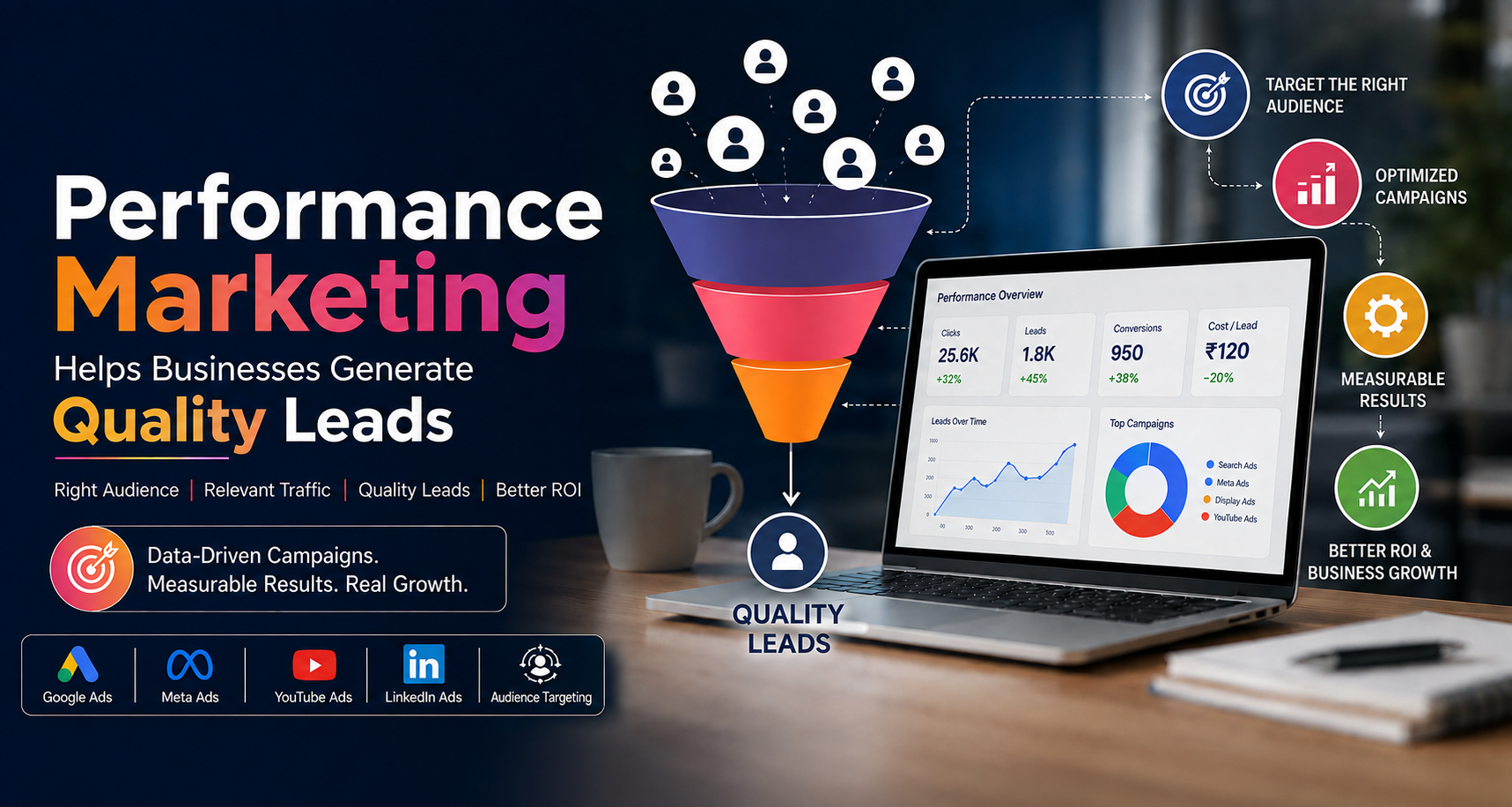
In today’s competitive digital marketplace, generating leads is not simply about reaching a large audience. Businesses need to connect with the right audience, attract genuine prospects, and turn marketing investments into measurable business outcomes. This is where performance marketing becomes a powerful growth strategy.
Unlike traditional advertising, performance marketing focuses on measurable actions such as clicks, enquiries, leads, registrations, and conversions. By combining targeted advertising, audience data, creative content, analytics, and continuous optimization, businesses can build campaigns designed around actual results.
What Is Performance Marketing?
Performance marketing is a results-driven form of digital advertising where campaigns are planned and optimized according to specific business objectives. Instead of focusing only on impressions or reach, marketers track important metrics such as cost per lead, conversion rate, return on ad spend, and customer acquisition cost.
Platforms such as Google Ads, Meta Ads, YouTube, and other digital advertising channels can help businesses reach potential customers based on their interests, search behaviour, demographics, location, and online activities.
The biggest advantage is measurability. Businesses can identify which campaigns, audiences, advertisements, and landing pages are producing results and allocate their budgets accordingly.
How Performance Marketing Generates Quality Leads
1. Precise Audience Targeting
One of the biggest reasons performance marketing works for lead generation is its ability to target specific customer segments. Instead of showing advertisements to everyone, campaigns can focus on people who are more likely to need or purchase a particular product or service.
Businesses can target audiences based on factors such as location, interests, search intent, demographics, online behaviour, and previous interactions with the brand.
This precision helps reduce wasted advertising spend while improving the possibility of attracting relevant prospects.
2. High-Intent Search Advertising
Search advertising can connect businesses with users who are already looking for a product or service. For example, someone searching for a digital marketing agency, healthcare service, industrial solution, or business consultancy may already have a strong purchase intention.
Well-structured PPC campaigns can place a business in front of these high-intent users at the right stage of their buying journey.
3. Conversion-Focused Landing Pages
Generating traffic is only one part of successful lead generation. Businesses also need a website or landing page that encourages visitors to take action.
A conversion-focused landing page should communicate the value proposition clearly, provide relevant information, build trust, and make it easy for users to submit an enquiry, request a consultation, call the business, or complete another desired action.
Performance marketing teams can test different headlines, creatives, offers, forms, and calls-to-action to improve conversion rates.
4. Continuous Campaign Optimization
Digital advertising should never be treated as a “set it and forget it” activity. Campaign performance can change based on audience behaviour, competition, creative fatigue, market conditions, and advertising costs.
Performance marketing allows marketers to monitor results and continuously optimize campaigns. Underperforming advertisements can be modified or paused, while successful campaigns can receive more attention and budget.
This data-driven approach helps businesses make smarter marketing decisions.
Measuring Lead Quality, Not Just Lead Quantity
Getting hundreds of leads does not necessarily mean a campaign is successful. If most enquiries are irrelevant or unlikely to convert, the business may still waste time and money.
That is why quality should be an important performance metric.
Businesses can evaluate leads based on factors such as:
• Relevance to the target customer profile
• Purchase intent
• Enquiry quality
• Lead-to-customer conversion rate
• Customer acquisition cost
• Revenue generated from leads
Connecting advertising data with CRM or sales data can provide a clearer picture of which campaigns are actually contributing to business growth.
Real Results: Substance Communication Case Studies
The value of performance-focused digital marketing can be seen through Substance Communication’s client case studies, covering brands across FMCG, healthcare, manufacturing, e-commerce, and other industries. (Substance Communication Case Studies)
For Ralfh Senses, a premium incense and dhoop brand, Substance Communication worked across branding, packaging, photography, advertising, website development, SEO, and digital marketing. The brand achieved first-page rankings for several targeted keywords, helping strengthen its online visibility. This demonstrates how performance marketing can work alongside SEO, branding, creative content, and a conversion-focused website.
For KPG Masale, an FMCG brand, digital marketing and influencer-focused strategies were used to connect the brand with relevant consumers. Combining engaging content with targeted digital campaigns can help consumer brands increase awareness and create opportunities for product discovery and sales.
The Jindal Ecotex case study demonstrates the importance of professional communication for B2B businesses. Through corporate photography and catalogue design, the brand was able to present its products and manufacturing capabilities more effectively to potential buyers.
Substance Communication also highlights broader measurable results, including a 300% increase in website traffic for a healthcare client within six months and 200% growth in online sales for a retail brand through targeted social media campaigns. These examples show why performance marketing should focus on meaningful business outcomes rather than simply generating impressions or clicks. (Substance Communication)
Why Businesses Need a Data-Driven Approach
Performance marketing combines creativity with analytics. Attractive advertisements may generate attention, but data helps determine whether that attention is turning into meaningful business results.
A strong strategy typically involves:
Research → Audience Targeting → Campaign Creation → Launch → Tracking → Optimization → Conversion
This process allows marketers to learn from campaign data and continuously improve performance.
Why Choose Substance Communication for Performance Marketing?
Substance Communication combines creative thinking with digital marketing expertise to help brands build stronger digital strategies. The agency works across digital marketing, brand building, creative content, websites, and other marketing services, creating opportunities to connect communication with business objectives.
Its performance marketing approach focuses on measurable outcomes, targeted campaigns, optimization, analytics, and lead generation. The agency also highlights expertise across platforms such as Google Ads and social media advertising.
For businesses looking to improve lead generation, the objective should not simply be to increase clicks. It should be to attract the right people, provide them with the right message, and guide them toward becoming valuable customers.
Conclusion
Performance marketing helps businesses generate quality leads by combining targeted advertising, measurable data, conversion optimization, and continuous campaign improvement.
The goal is not simply to generate more clicks or impressions. It is to reach the right audience, communicate the right message, generate relevant enquiries, and convert those opportunities into business growth.
With the right strategy, tracking, creative execution, and optimization, performance marketing can become a scalable channel for generating quality leads and improving marketing ROI.
Substance Communication brings together strategy, creativity, technology, analytics, and performance-focused marketing to help brands move from visibility to leads and from leads to growth.